What Are the Causes of Cervical Insufficiency?
Back to BlogPregnancy

What Are the Causes of Cervical Insufficiency?

Medically reviewed by the Garden OB/GYN Team·May 13, 2026· 6 min read

Cervical insufficiency is a well understood condition, and with the right monitoring and care many people go on to have healthy pregnancies.

The Reassuring Bottom Line

  • There is not always one clear cause, and sometimes no specific reason is found. Common factors include prior cervical procedures, past preterm birth or second trimester loss, and certain congenital differences.
  • Having a risk factor does not mean you will develop it. It just means your provider may watch you a little more closely.
  • A simple transvaginal ultrasound can measure your cervical length, so changes can often be caught early with regular prenatal care.
  • If your risk is higher, your team can tailor a plan that may include a cerclage stitch, progesterone, or repeat ultrasounds to keep you and your baby safe.

If you have been told you may have cervical insufficiency, also called an incompetent cervix, it is natural to feel worried, especially if you have experienced a pregnancy loss before. The good news is that this condition is well understood, and with the right monitoring and care, many people go on to have healthy pregnancies. Here is what causes it and how it is managed.

What Is Cervical Insufficiency?

The cervix is the lower, narrow end of the uterus that connects to the vagina. During a healthy pregnancy, the cervix stays firm and closed until near the end of pregnancy, when it gradually softens and opens to prepare for birth. In cervical insufficiency, the cervix begins to shorten and open too early, often during the second trimester, without the usual contractions or pain of labor.

Because this can happen quietly, it may lead to late pregnancy loss or premature birth. Understanding the causes and risk factors helps your provider watch for it and act early.

What Causes Cervical Insufficiency?

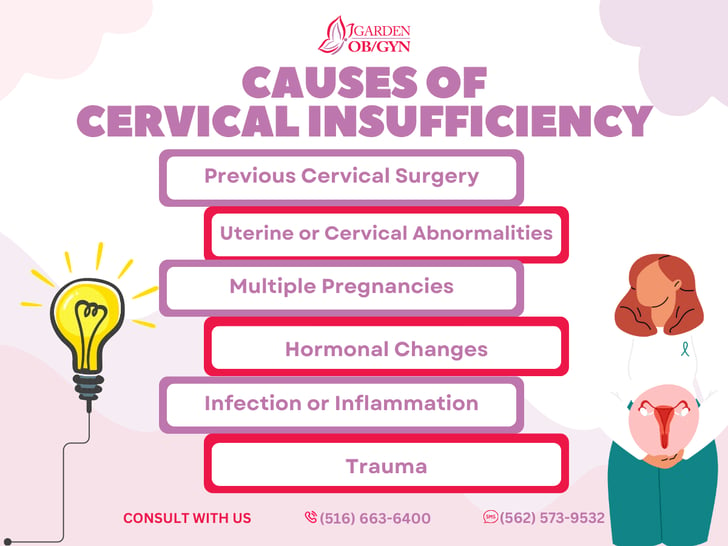
There is not always a single, clear cause, and in some cases no specific reason is identified. More often, it relates to one or more of the following:

  • Prior cervical surgery or procedures: Treatments for abnormal cervical cells, such as a LEEP (loop electrosurgical excision procedure) or cone biopsy, can remove or weaken cervical tissue.
  • Cervical trauma: Injury to the cervix from a prior difficult delivery, or from procedures that involve dilating the cervix, can affect its strength.
  • Congenital factors: Some people are born with differences in the structure of the cervix or uterus, or with connective tissue conditions that affect how the cervix holds together.
  • Prior preterm birth or second-trimester loss: A history of an early birth or a painless second-trimester loss is one of the strongest signals that cervical insufficiency may be present.
  • Prior exposure to certain medications: A small number of people exposed before birth to medications once used in pregnancy may have structural differences in the cervix.

Having a risk factor does not mean you will definitely develop cervical insufficiency. It simply means your provider may recommend closer monitoring.

Who Is at Higher Risk?

You may be considered at higher risk if you have any of the history above. Your provider will review your medical and obstetric history carefully at your first prenatal visit. Be sure to mention:

  • Any previous pregnancy that ended in the second trimester, especially without painful contractions
  • Any history of preterm birth
  • Past cervical procedures, biopsies, or surgeries
  • Known differences in the shape of your uterus or cervix
  • A family history of similar pregnancy complications

Sharing this information helps your care team decide whether you would benefit from extra ultrasounds or other preventive steps.

How Is Cervical Insufficiency Detected?

Cervical insufficiency is often identified in one of two ways. The first is through your history, when a pattern of painless second-trimester loss or early birth points to it. The second is through monitoring during a current pregnancy.

The most common monitoring tool is a transvaginal ultrasound that measures the length of your cervix. A cervix that is shortening earlier than expected can be an early sign. For people with risk factors, your provider may schedule a series of these ultrasounds during the second trimester to track any change over time.

In some cases, cervical insufficiency is discovered during a routine exam when the cervix is found to be opening without symptoms. Because the changes can be silent, regular prenatal care is one of the best ways to catch it early.

How Is It Managed During Pregnancy?

Management depends on your history, how far along you are, and what is found on ultrasound. Your provider will tailor a plan to your situation, which may include:

  • Cervical cerclage: This is a stitch placed around the cervix to help keep it closed. It is often considered for people with a relevant history or a short cervix found on ultrasound, and it is usually removed later in pregnancy before delivery.
  • Progesterone support: In certain situations, your provider may recommend progesterone to help reduce the risk of preterm birth. The right form and timing are decisions to make with your provider.
  • Serial cervical length monitoring: Repeated transvaginal ultrasounds allow your team to watch for early changes and act quickly if needed.
  • Activity guidance: Depending on your circumstances, your provider may discuss adjustments to your daily activity. These recommendations are individualized.

Professional organizations such as the American College of Obstetricians and Gynecologists (ACOG) provide guidance that your provider uses to shape these decisions. Every pregnancy is different, so your plan should always be made together with your care team.

When Should You Seek Care Right Away?

Cervical insufficiency can progress without the typical signs of labor, so it is important to pay attention to your body. Contact your provider promptly or go to the nearest emergency room if you experience any of the following during the second trimester or later:

  • A new feeling of pelvic pressure or heaviness, as if something is pushing down
  • A backache that is new for you
  • Mild cramping or a change in the type of cramps you feel
  • A change in vaginal discharge, such as more fluid, mucus, or a watery leak
  • Any vaginal bleeding or spotting
  • A gush or steady trickle of fluid, which can signal your water has broken

When in doubt, it is always better to call. Reaching out early gives your team the best chance to help.

Cervical Insufficiency Care at Garden OB/GYN

At Garden OB/GYN, our team supports people through higher-risk pregnancies with attentive monitoring, clear communication, and individualized care plans. If you have a history that raises your risk, we can review it with you, arrange cervical length ultrasounds, and discuss whether options like cerclage or progesterone are appropriate for your situation. With locations across NYC and Long Island, we make it easier to get the close follow-up that this condition can require.

You do not have to navigate this alone. Our providers are here to answer your questions and walk with you through every step of your pregnancy.

Schedule an appointment with Garden OB/GYN to talk with a provider about your risk factors and the right monitoring plan for you.

This article is for general education and is not a substitute for medical advice. If you are experiencing severe symptoms, seek care right away.

When to call Garden right away

Get in touch with us, or seek emergency care, if you have:

  • New pelvic pressure or heaviness, as if something is pushing down
  • A new backache
  • Mild cramping or a change in the cramps you feel
  • A change in vaginal discharge, such as more fluid, mucus, or a watery leak
  • Any vaginal bleeding or spotting
  • A gush or steady trickle of fluid that could mean your water has broken
Book Your Appointment

From our doctors

You do not have to navigate this alone. Share your history with us, and we will build a monitoring plan that keeps you and your baby cared for every step of the way.

the Garden OB/GYN Team

cervical insufficiencyincompetent cervixpregnancycerclagepreterm birthhigh-risk pregnancy

Have a question about your health?

Our caring providers across NYC and Long Island are here for you. Talking it through is the first step.

Book Your Appointment